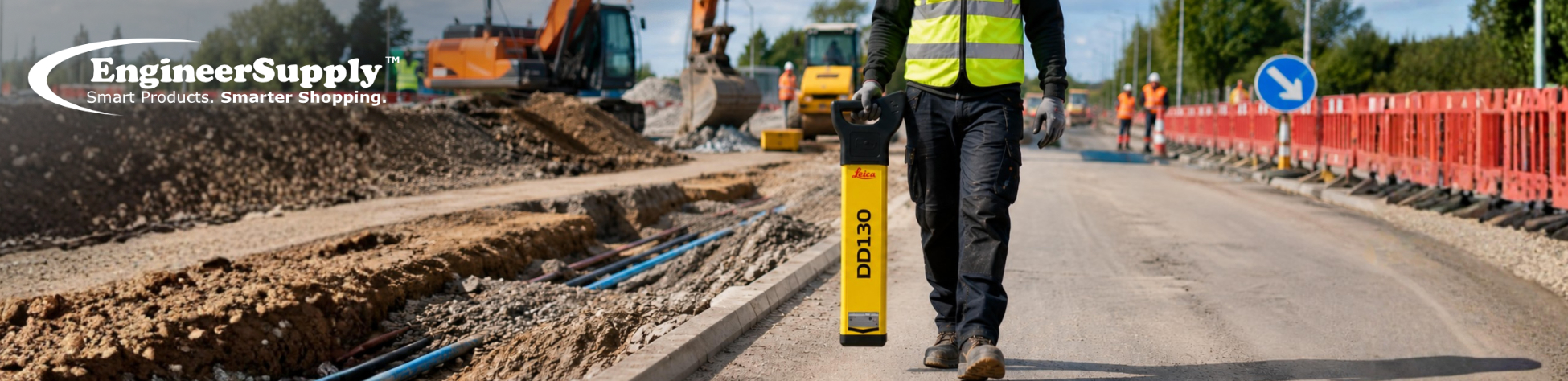
Underground utility strikes remain one of the most expensive and dangerous construction incidents on job sites. Even experienced crews can make small locating mistakes that lead to major damage, downtime, and safety risks.
The Leica DD130 underground utility locator is designed to improve detection accuracy and safety, but proper technique is just as important as equipment quality.
This guide explains the most common utility locating mistakes, why they happen, and how to avoid them in real field conditions.
What is the Leica DD130?
The Leica DD130 is an electromagnetic underground utility locator used to detect buried conductive utilities such as:
- Power cables
- Water and gas lines (when traceable)
- Telecom and fiber ducts (with tracer systems)
It works with signal transmitters like the Leica DA220 and DA230, and supports:
- Passive detection (existing signals)
- Active tracing (transmitter applied signal)
- Sonde detection for non-metallic utilities
Important: It does NOT directly detect non-conductive pipes unless a sonde or tracer wire is used.
Why Utility Locating Errors Matter
Underground infrastructure is complex and constantly changing. Records may be incomplete, outdated, or inaccurate.
Common consequences of a utility strike:
- Jobsite shutdowns
- Expensive repair costs
- Safety hazards (gas, electric, water damage)
- Project delays and contractual penalties
Industry data (Common Ground Alliance) shows utility damage incidents occur frequently across active construction zones, often due to preventable field errors rather than equipment failure.
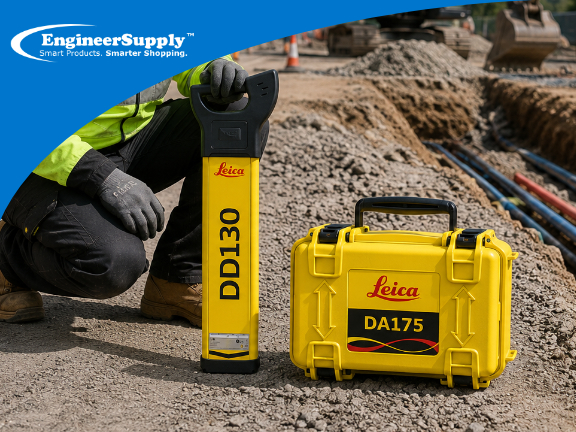
Mistake #1 –Trusting outdated utility maps
The Mistake:
Treating utility maps or as-built drawings as fully accurate.
Utility records are useful, but they age quickly. Lines get rerouted, patched, or installed without proper documentation. Older projects are even more inconsistent.
When crews treat maps as exact truth, surprises happen underground.
The Fix:
Use maps as a reference only. Confirm everything in the field with active detection. The DD130 power and radio modes help identify utilities that never made it into drawings.
Mistake #2 – Relying only on passive locating
The Mistake:
Scanning only in passive mode using power or radio signals without a transmitter.
Passive locating picks up signals that are already present, like live power lines or cables radiating frequencies. It works, but it is limited.
Anything inactive or not radiating a signal will be missed.
The Fix:
Pair passive scanning with active locating using a transmitter like the DA220 or DA230. Active mode places a controlled signal on the line, which makes tracing more reliable and depth estimation possible.
Passive is a quick sweep. Active is the confirmation step.
Mistake #3 – Improper transmitter grounding
The Mistake:
Poor ground stake placement or dry soil conditions.
If grounding is off, the signal return path weakens. That leads to faint, unstable, or misleading traces. Dry soil makes this worse because resistance increases and the signal spreads unpredictably.
The Fix:
Place the ground stake far enough from the target line, ideally 10 feet or more when possible. Set it at a right angle to the suspected path. If the soil is dry, add water around the stake to improve conductivity.
Good grounding makes everything else more stable.
Mistake #4 – Choosing the wrong frequency
The Mistake:
Using high frequency for long distances or low frequency where signal break detection is needed.
Frequency controls how the signal behaves underground. High frequency travels easily but can bleed into nearby utilities. Low frequency stays tighter but does not always travel far enough.
The Fix:
Match frequency to conditions. The DD130 offers 512 Hz, 640 Hz, 8 kHz, and 33 kHz.
Frequency guide for the DD130:
- 512 Hz / 640 Hz – long distance tracing and deeper utilities
- 8 kHz – general locating in mixed conditions
- 33 kHz – short runs, signal jumping, or insulated lines
In crowded utility areas, start low to reduce interference, then increase only if needed.
Mistake #5 – Missing non metallic utilities
The Mistake:
Assuming all buried utilities can be detected directly.
Electromagnetic locators only detect conductive materials. Plastic pipes, PVC, and HDPE lines do not carry a signal on their own.
The Fix:
Use a sonde or tracer wire. A sonde placed inside a pipe emits a detectable signal that the DD130 can follow. The device supports 512 Hz sondes, which makes this method effective for non-metallic utilities.
Mistake #6 –Treating depth readings as exact
The Mistake:
Digging based on the displayed depth as if it is a precise measurement.
Depth readings are calculated from signal behavior. They shift depending on soil conditions, nearby utilities, cable shape, and even how the locator is held.
A reading can look precise and still be off by a noticeable margin.
The Fix:
Use depth as a guide only. When you get close to the utility, stop relying on the number and expose it manually.
The DD130 Hazard Zone alert helps here by warning when a utility is within roughly 1 foot of the surface.
Mistake #7 – Failing to re-verify markings
The Mistake:
Assuming marks made at the start of a job stay valid throughout the project.
Paint fades. Flags move. Soil gets disturbed. And once digging starts, nearby conditions can change how signals behave.
The Fix:
Recheck at the start of every day and whenever the work area changes. On active sites, treat locating as an ongoing process, not a one-time task.
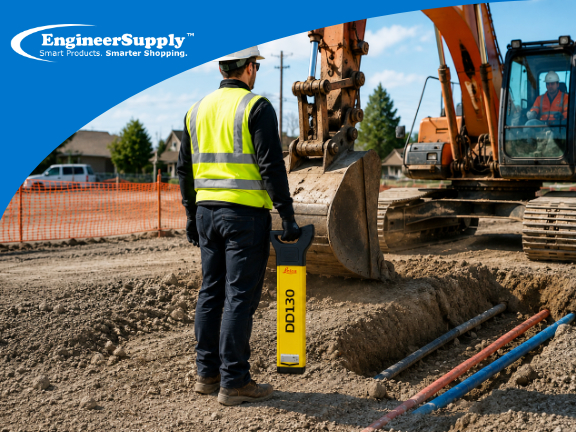
Mistake #8 – Using heavy machinery in the tolerance zone
The Mistake:
Staying on machine excavation too close to marked utilities.
The tolerance zone is where marking accuracy is no longer guaranteed. Small errors in position become dangerous fast.
The Fix:
Switch to hand tools or vacuum excavation once you reach 18–24 inches from a marked utility. This gives you control and reduces the risk of contact.
This is standard practice on most professional excavation sites.
Mistake #9 – Ignoring Signal Distortion
The Mistake:
Misinterpreting unstable or shifting signals as valid utility paths.
Signal distortion can be caused by nearby utilities, metal structures, poor grounding, or electrical interference.
Warning signs include fluctuating signal strength, multiple peaks, and inconsistent tracing paths.
The Fix:
Do not rely on a single reading. Change direction, switch frequencies, and compare results from multiple passes. If instability continues, expose the utility before proceeding.
How the Leica DD130 Helps Reduce These Mistakes
The DD130 improves locating reliability through:
- Multi-frequency detection (low to high signal control)
- Passive + active locating modes
- Sonde compatibility for non-metallic utilities
- Signal strength indicators for clearer tracing
- Built-in self-test for operational accuracy
- Hazard zone alerts for shallow utility proximity
Ready to dig more safely and accurately?
Successful underground utility locating depends on combining three things:
- Reliable equipment
- Proper technique
- Consistent verification
The DD130 supports safe excavation through multiple frequencies, hazard alerts, and depth estimation features but it cannot replace professional judgment.
The safest crews are not the ones who never encounter uncertainty. They are the ones who recognize uncertainty early and respond with proper verification methods every time.
For professional-grade utility locating equipment and expert support, explore solutions available at Engineer Supply.
For a Quote or Personalized Guidance:
Call or Text: 434-755-7717
Email: sales@engineersupply.com
Need Assistance with Your Leica DD130 Utility Locator?
Our service and support team can assist with Leica DD130 setup, troubleshooting, diagnostics, performance checks, and general maintenance support to help keep your equipment operating reliably in the field.
Customer Support: 800-591-8907
Repairs & Maintenance: Call or Text 434-200-8477
FREQUENTLY ASKED QUESTIONS
What causes most underground utility strikes?
Most strikes occur due to outdated maps, passive-only locating, grounding issues, and failure to verify signal accuracy in the field.
Can the Leica DD130 detect all utilities?
No. It detects conductive utilities directly and non-metallic utilities only when used with a sonde or tracer wire system.
Is depth reading on the DD130 accurate?
Depth readings are estimates influenced by soil conditions, signal strength, and nearby utilities. They should always be used as guidance, not exact measurement.
What is the safest excavation practice near utilities?
Switch to hand tools or vacuum excavation within the defined tolerance zone and always re-confirm utility locations before digging.
Where to buy the Leica DD130?
You can purchase the Leica DD130 directly from Engineer Supply, a trusted source for professional construction and surveying equipment. They provide genuine equipment along with warranty support, calibration services, and expert assistance for utility locating tools.
More Locating Underground Utilities