Accurate measurements are essential for any surveying project, from land mapping to infrastructure planning. Total stations make this easier by combining distance measurement, angle calculation, and data recording in a single device.
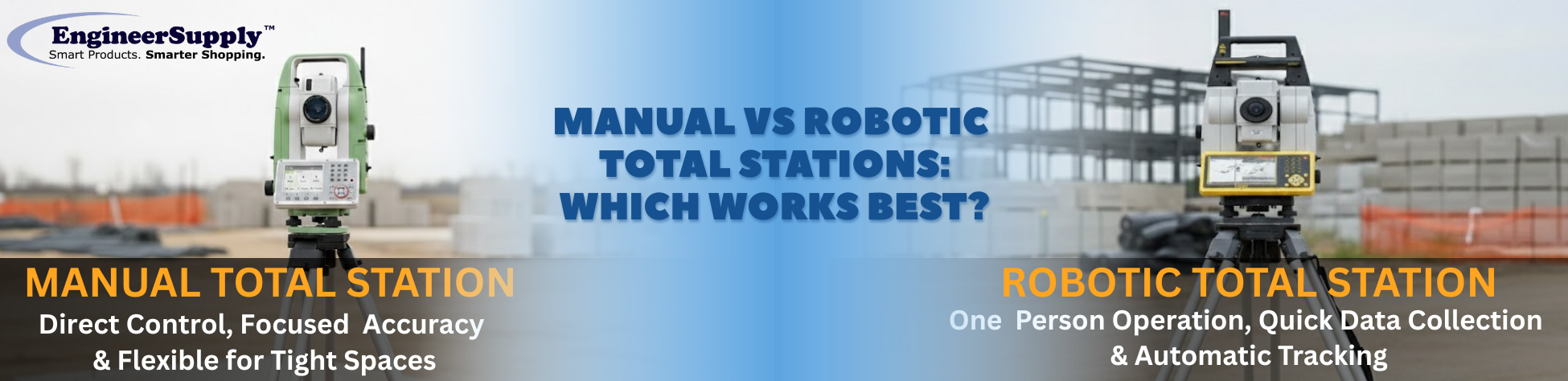
When choosing a total station, surveyors face an important decision: manual or robotic. Manual total stations are operated directly by a surveyor, ideal for smaller projects and simpler tasks. Robotic total stations use automation and remote control, speeding up work and reducing labor for larger, more complex projects. Understanding the differences helps teams select the right tool for their needs

What is a Manual Total Station?
A manual total station is a traditional tool that combines a theodolite with electronic distance measurement (EDM). Surveyors use it to measure angles, distances, and heights. It requires at least two people: one operates the instrument while the other holds the prism rod. Measurements are recorded by hand, so the outcome depends on how carefully the surveyor works. Learning how a manual total station operates can help teams understand the care needed for precise measurements.
What Are the Features of Manual Total Stations?
Manual total stations are designed for surveyors who need direct control over every measurement. The telescope allows you to sight points clearly, while the processor captures both angles and distances, storing the data for immediate or later use.
These instruments are built to perform in the field. Data can be transferred easily through USB or Bluetooth, and the rugged construction with weather-resistant housing ensures consistent operation. Manual stations are ideal when accuracy, flexibility, and hands-on management are critical to the project.
When to Use Manual Total Stations
Manual total stations are best suited for projects where hands-on control and flexibility are essential. They perform well in environments where close monitoring of measurements is required or where site conditions make automated equipment less practical. Typical situations include:
- Small to mid-sized construction sites where the team can manage measurements directly
- Property and boundary surveys that require careful targeting of specific points
- Layout work for roads, buildings, or utility installations on compact sites
- Tasks where adjustments or re-measurements need to be made on the spot
- Training or situations where surveyors are building experience with total station operations
Pros and Cons of Manual Total Stations
Before choosing a manual total station, it’s important to understand where it excels and where it can be less efficient. These instruments are built for surveyors who need direct control over measurements, but they come with limitations depending on project size and complexity.
Pros
- Cost-Effective: Manual total stations are generally less expensive than automated models, making them suitable for smaller projects or teams with limited budgets.
- Direct Control: Operators handle every measurement, which allows on-the-spot adjustments and greater oversight of each point.
- Durability: With fewer automated components, manual units tend to be more resilient under rough conditions and require simpler maintenance
- Focused Accuracy: When used properly, manual stations deliver reliable results, especially on projects where the surveyor’s judgment and positioning make a difference.
- Flexible for Tight Spaces: Smaller or irregular sites benefit from manual operation, where robotic systems may struggle to navigate or require additional setup.
Cons
- Time-Intensive: Collecting data point by point requires more hands-on work, which can slow progress on large sites.
- Human-Dependent: Accuracy relies heavily on the operator’s skill, which increases the chance of errors if the surveyor is inexperienced or fatigued.
- Limited Automation:They lack features such as remote control, automatic target tracking, or integrated scanning, which can reduce efficiency on complex or high-volume projects.
- Not Ideal for Large Teams or Sites: Projects that demand fast, repeatable measurements over long distances are better suited to robotic systems.
In short, manual total stations are best for projects that benefit from direct oversight, careful measurement, and flexible handling, while larger, high-speed projects may require automation for efficiency.
What is a Robotic Total Station?
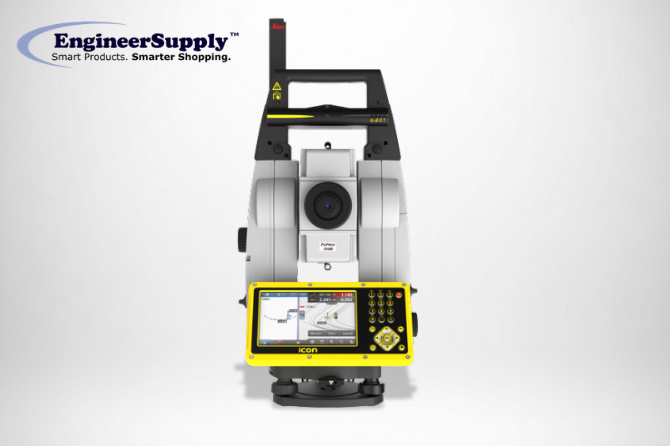
A robotic total station is a surveying tool that measures distances and angles automatically. It can follow a prism and record measurements on its own, so someone doesn’t have to stay at the instrument all the time.
Surveyors control it using a tablet or field controller, which means one person can do the work that normally takes a team. This makes surveys faster, reduces mistakes, and makes it easier to work in large or hard-to-reach areas.
Robotic total stations are best for big projects, complex layouts, or sites where efficiency and safety matter. They save time while keeping measurements accurate and organized.
What Are the Features of Robotic Total Stations?
Robotic total stations are made for surveyors who need to work faster with fewer people. The instrument can be controlled from a distance, and it automatically follows the prism to keep measurements accurate without constant adjustments.
Data is recorded automatically and can be sent quickly through Bluetooth or Wi-Fi. The instruments are built strong, with weather-resistant housing, so they work reliably in tough field conditions. Robotic total stations are best when speed, accuracy, and fewer crew members are needed on a project.
When to Use Robotic Total Station
Robotic total stations are best for large sites where survey points are far apart. They are useful when one surveyor needs to handle layout and measurements without a second person at the instrument. Remote control and automatic prism tracking make it easier to work across the site without constant repositioning.
They are commonly used in:
- Large construction projects with wide layout areas
- Road and highway work that covers long distances
- Bridge and utility installation projects
- Land surveys that require recording many points
- Areas that are difficult or unsafe to access directly
In these cases, a robotic total station helps complete the work with fewer crew members while keeping measurements steady across the project.
Pros and Cons of Robotic Total Stations
Before using a robotic total station, it’s important to know what it does well and where it may not be needed. These instruments work best on large sites where many measurements are needed, but they might be too much for small or simple jobs.
Pros
- One-Person Operation:One surveyor can control the instrument while moving the prism, so fewer people are needed on site
- Automatic Tracking: The instrument follows the prism automatically, keeping measurements steady across the site.
- Quick Data Collection: Measurements are stored digitally right away, so there’s less writing and fewer mistakes.
- Consistent Results: Once set up, the instrument keeps points aligned and accurate over long distances.
- Safer Work:Surveyors can operate it from a distance in areas that may be unsafe or hard to reach.
Cons
- Higher Price:Robotic stations cost more than manual ones, which may not be worth it for small jobs.
- Needs Training: Operators must know how to set up and control the instrument to get correct results.
- Battery Dependence: The instrument needs charged batteries, so power must be managed during the workday
- More Maintenance: With motors and electronics, it needs regular checks to keep working well.
In short, robotic total stations are best for large or complex projects where one surveyor can handle the work and keep measurements steady. For small sites or simple jobs, a manual total station is often easier and cheaper.
Manual vs Robotic Total Stations
| Feature |
Manual Total Station |
Robotic Total Station |
| Measurement Method |
Manual sighting of prism; angles and distances read on the instrument |
Motorized prism tracking; angles and distances recorded automatically |
| Stored manually in instrument memory or logged on paper |
Digital storage in controller with immediate transfer to software |
|
| Prism Tracking |
Operator must manually align and follow the prism |
Automatic prism tracking with continuous measurement, even if the prism moves |
| Range |
Depends on optics; typically up to 1–3 km for standard prisms |
Can reach longer distances (up to 5 km or more) with advanced tracking and stronger EDM |
| Repetition of Points |
Manual repositioning required for repeated measurements |
Can measure the same point repeatedly without resetting the instrument |
| Field Setup |
Leveling and alignment at each station is manual |
Once control points are established, minimal manual adjustment needed |
| Measurement Speed |
Limited by operator movement and manual sighting |
High-speed measurement; several points per minute possible |
| Connectivity |
Usually USB or data cable transfer |
Built-in Bluetooth, Wi-Fi, or radio for real-time connection to controller or office software |
| Power Supply |
Simple battery; low drain |
Motors and controller require higher capacity batteries; power management needed |
| Maintenance |
Minimal; few moving parts |
More frequent servicing required for motors and electronics to maintain accuracy |
| Best Use Cases |
Small sites, tight spaces, education, boundary surveys |
Large construction, road/highway projects, bridges, utilities, long corridor surveys |
Manual vs Robotic Total Stations: Which Should You Choose?
Choosing the right total station depends on your project size, team, and priorities:
- Manual Total Stations are ideal for small sites, hands-on control, and situations where precision adjustments are key.
- Robotic Total Station excel on large or complex projects where speed, efficiency, and fewer personnel are needed.
Ready to Choose Your Total Station?
At Engineer Supply, we help construction teams find the best total station for their projects. Whether you prefer the hands-on control of manual instruments or the efficiency and speed of robotic total stations, our experts can guide you to the perfect fit.
For a Quote or Personalized Guidance: Contact our sales team.
Call or Text: 434-755-7717 | Email: sales@engineersupply.com
Having Issues with Your Total Station?
Whether you have questions about your order, setup, or keeping your manual or robotic total station working accurately, we’ve got you covered. Our Service repair team can assist with orders and general inquiries, while our technicians handle calibration, repair, and maintenance to keep your instruments field-ready and performing at their best.
Customer Service: 800-591-8907
Repairs & Maintenance: Call or Text 434-200-8477