Surveying is all about precision, especially when it comes to measuring distances. Whether it’s for a new construction project, determining property lines, or mapping out land, accuracy matters. Over time, the methods and tools used by surveyors have evolved to offer faster and more accurate measurements. Let’s break down how surveyors measure distance and why it matters.
Early Methods: Direct Distance Measurement (DDM)
Surveyors rely on direct distance measurement (DDM) using metal tapes for many years. One standard tool was the 100-foot metal tape, which surveyors used to measure distances manually across land. A chain of 66 feet (known as a Gunter’s chain) was often used, with each chain consisting of 100 links. This was the standard method before the 1980s, and it allowed for decent accuracy—about 1 part in 10,000.
While this method worked well for smaller distances, it had its flaws. Depending on the weather, the tape could stretch or shrink, and human error could easily creep in. Despite these challenges, skilled surveyors were able to achieve fairly accurate measurements. However, as land surveying demands grew, this technique became less practical.
Enter Electronic Distance Measurement (EDM)
By the 1980s,electronic distance measurement (EDM) devices took over, offering a faster and more accurate way to measure distances. These devices use lasers to measure distances by sending a beam toward a reflector and measuring the time it takes to bounce back. The device converts the time delay into a precise distance. The iM-100 from SOKKIA is an example of an EDM device that surveyors use today.
EDM devices provide incredible accuracy, with a precision of 1 part in 20,000, a huge improvement over traditional tape measures. The downside, however, is that EDM doesn’t work well in difficult terrain or when there are obstructions. For example, it can struggle to get a clear reading if you're working in a dense forest or over a large body of water.
Measuring Property Lines
When surveying property lines, surveyors first check the initial property survey recorded in local municipal offices. This survey shows the original layout of the land, often using survey monuments or rebar placed at key points (like the corners of the property). Surveyors then use modern surveying equipment to take accurate measurements around the property to verify and mark the exact property lines.
These measurements help ensure boundaries are respected, avoiding disputes between property owners. It is critical for everything from building homes to managing land for agricultural use.
Modern Units of Measure
In the past, surveyors used a "chain" (66 feet) as a unit of measure, but today, rods, poles, or perches are more common. A rod is equal to 16.5 feet or 5.5 yards. It’s a helpful measurement because whole numbers multiply easily to form an acre of land—an acre consists of 160 square rods.
This unit of measure comes from traditional surveying tools. It’s straightforward to deal with larger areas, especially in rural or agricultural surveying. It helps map out large properties, whether marking out a boundary for construction or calculating the exact location for farming.

The Importance of Accuracy
Surveyors rely on electronic devices like EDM instruments to get the most accurate readings. Several types of EDM devices vary in range and precision. For example, microwave instruments can measure distances up to 100 kilometers, while infrared wave instruments typically have a range of about 3 kilometers and an accuracy of +/—10 millimeters. Lightwave instruments are highly accurate, with error margins of as little as 0.5 mm per kilometer.
The size of the project and the terrain decide which tool to choose. A surveyor may need a different instrument to measure a small residential property than a large commercial or government project. Temperature and humidity can affect the measurements, so you must calibrate the tool to get reliable results.
Triangulation and Trilateration: Traditional Methods
Before EDM, surveyors used triangulation to measure distances. This method involves forming a triangle between three points and measuring the angles. Once the angles are known, trigonometry helps calculate the distances. However, triangulation only works if the points are visible and accessible, which isn’t always true in rugged landscapes.
Surveyors used triangulation networks to create large-scale maps, with each new measurement improving the map's accuracy. Theodolites, devices used to measure angles, played a significant role in this process.
Later, trilateration came into play. This method, which became popular in the 1950s, uses known distances between points and the speed of light to measure long distances with high accuracy. Instruments like the Tellurometer (microwave-based) and Geodimeter (light-based) were key in making these measurements possible over larger distances. Unlike triangulation, where angles are measured, trilateration directly measures the distances between points.
Traversing: Measuring Over Flat Terrain
Triangulation and trilateration can be difficult or impossible in some areas, like flat fields. In these cases, surveyors use traversing to measure distances and angles between several known points. The chain of measurements can be closed by returning to the starting point, allowing surveyors to verify accuracy and account for errors.
Surveyors correct errors in the traverse by adjusting the measurements. This method works well in areas without large hills or obstructions.
Tools Used for Accurate Measurement
Surveyors use various tools to measure distance and angles:
- Theodolite: This device measures horizontal and vertical angles with high accuracy, some measuring angles to a tenth of a second of arc—vital for long-distance measurements.
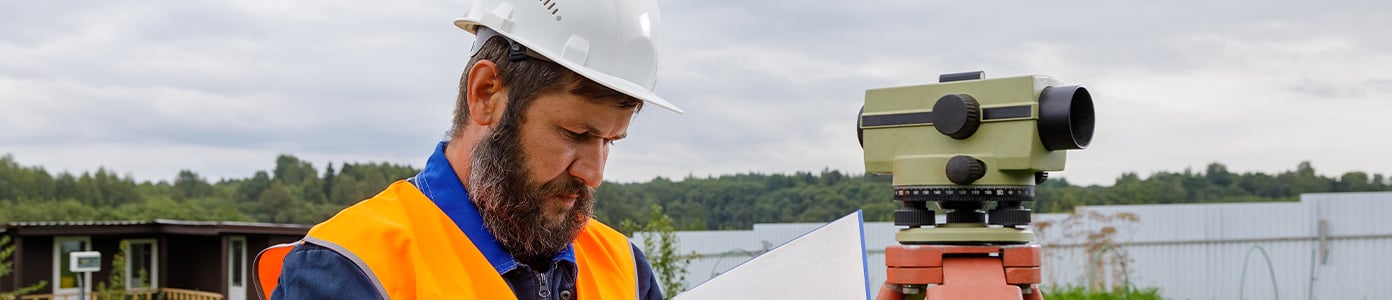
- Levels: Surveyors use levels to measure elevations, including the dumpy level, wye level, and automatic level.
- Solar Compass: This device determines the latitude and true north. It is especially useful in areas where magnetic compasses fail due to local magnetic fields. It also helps surveyors work effectively in challenging terrain.
Final Thoughts
Measuring distance is essential in surveying, and modern technology has made it easier and more accurate than ever. Surveyors rely on various tools and techniques to get the job done right, whether using tape measures, EDM devices, or older methods like triangulation and traversing. Accurate land measurements ensure clear boundaries and solid construction, playing a crucial role in land development and the longevity of projects.
FAQs About How Surveyors Measure Distance
What tools do surveyors use for measuring distance?
Surveyors use various tools, such as laser distance meters, theodolites (for measuring angles), and GPS systems. They also sometimes use older tools, like metal tapes and chains, for certain tasks.
Why do surveyors use different tools for measuring?
The size of the area and the terrain determine which tool surveyors choose. For example, surveyors use a long-range laser tool and a metal tape for smaller or more detailed measurements.
How does temperature affect surveying measurements?
Temperature can affect the materials used in tools like metal tapes, making them expand or contract. Surveyors account for this by calibrating their tools before taking measurements.
What is traversing in surveying?
Surveyors use traversing when working over flat areas. They measure distances and angles between points and check for accuracy by returning to the starting point.
Why is accurate distance measurement important in surveying?
Accurate measurements clear property lines and ensure construction projects are built correctly. This helps avoid disputes, ensures safety, and guarantees that projects stay within budget and on time.