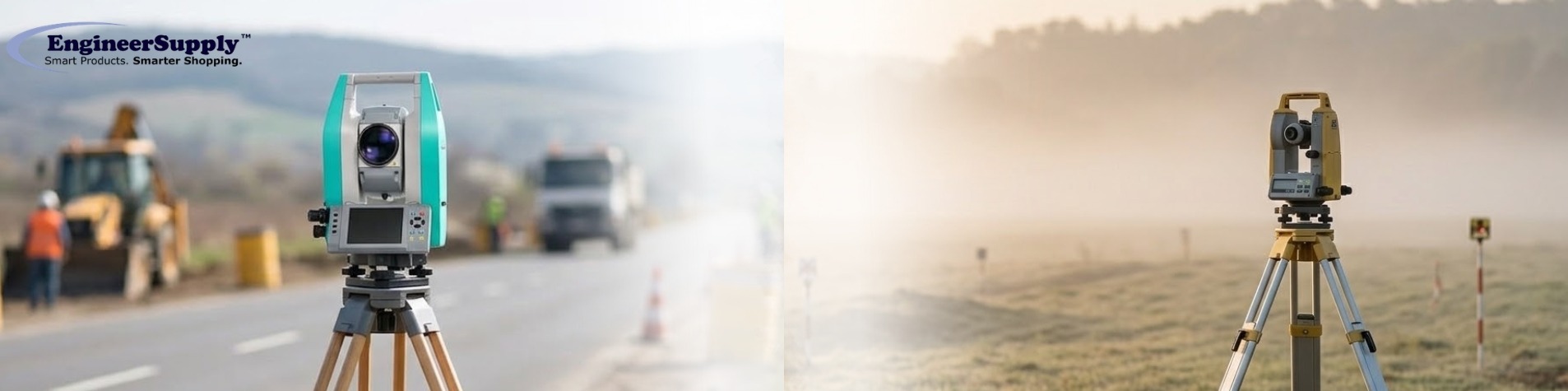
Which total station will give your project the best results.Nikon or Topcon? Both are designed to measure angles, distances, and layouts with ease, but knowing their strengths can help you choose the right one for your job.
Two of the most recognized brands in the surveying industry are Nikon and Topcon. Both companies produce high-quality total stations used for construction, engineering, and land surveying.
While they serve similar purposes, each brand focuses on different strengths. Nikon instruments are known for their clear optics and simple operation, while Topcon systems are often recognized for advanced technology and automated measurement solutions.
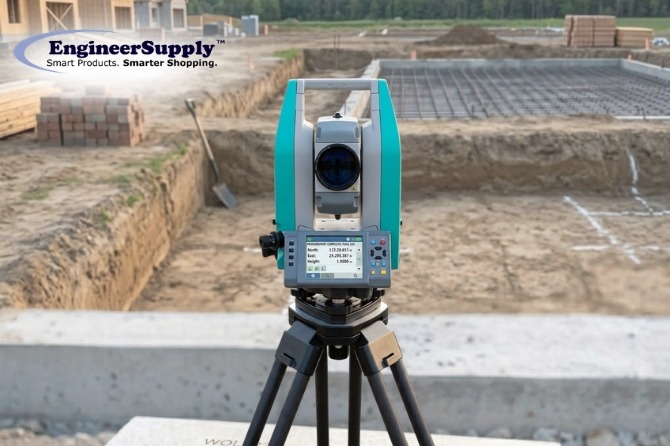
What is Nikon Total Station?
A Nikon Total Station combines a digital theodolite with an electronic distance meter (EDM) to measure distances and angles for construction and mapping. These tools are known for bright, clear optics and 1″ to 5″ accuracy, working reliably even in low light. They offer both prism and reflectorless measuring to reach difficult spots easily.
These lightweight units feature autofocus and hot-swappable batteries for all-day field use. Data transfers quickly to the office via Bluetooth or USB. With options like the nikon n series total station, nikon k series total station, nikon xf series and nikon xs total station, teams can easily find the best nikon total station for their specific project needs.
What Are the Features of Nikon Total Station?
Nikon Robotic Total Stations are designed to make surveying and construction easier and more exact. They are lightweight, portable, and easy to carry around the job site. Their bright, clear optics let you see targets even in low light, while autofocus keeps your measurements sharp and quick.
These Nikon Total Stations can measure distances to prisms or reflectorless points, with some models reaching up to 800 meters. They can store up to 50,000 points of data, which can be easily sent to a computer or field controller using Bluetooth or USB. Hot-swappable batteries let you work all day without stopping, and dual-face or backlit screens make them easy to use from any angle. Models like the N-series, K-series, XF, and XS offer angle accuracies from 1″ to 5″ for different projects. They also run built-in software for layout, surveying, or managing data, and are made to handle dust, water, and rough job site conditions.
When to Use a Nikon Total Station?
Nikon Total Stations are ideal for projects where getting correct measurements matters and data needs to be handled easily. They work well in different field conditions and for tasks that require consistent results.
Typical situations include:
- Construction layouts for marking building points or transferring digital plans to the field
- Land and boundary surveys that need exact property line measurements
- Topographic mapping and site measurements for engineering or infrastructure projects
- Long-distance or hard-to-reach points where bright optics make targeting easier
- Jobs that need all-day field use, thanks to long-lasting, hot-swappable batteries
Pros and Cons of Nikon Total Station
Before choosing a Nikon total station, it’s helpful to know what it does best and where it may have limitations. These instruments are designed for surveyors and construction teams who need clear visuals, good data handling, and all-day usability, but certain projects may call for more automated solutions.
Pros
- Clear Optics: Bright, sharp optics make it easy to see targets even in low-light conditions.
- Durable Design: Built to handle dust, rain, and tough job site conditions.
- Budget-Friendly: Offers strong performance at a lower price compared to high-end brands.
- Long Battery Life: Hot-swappable batteries keep work going throughout the day.
- Easy to Operate: Lightweight, portable, and straightforward software for quick setup.
- Smooth Data Transfer: USB-C and Bluetooth make sending data to computers or controllers simple.
Cons
- Limited Automation: Mostly manual or semi-manual, so not as fast as robotic stations.
- Software Learning Curve:Some onboard software may take time to get used to.
- Service Challenges: Fewer service centers for older models can slow maintenance.
- Smaller Memory on Older Units: Older or entry-level models may store fewer data points.
- Handling: Certain models can feel top-heavy or awkward to carry on site.
In short, Nikon total stations are ideal for projects that need clear sighting, good field data handling, and portability, while jobs requiring full automation or rapid high-volume measurements may be better suited to robotic systems.
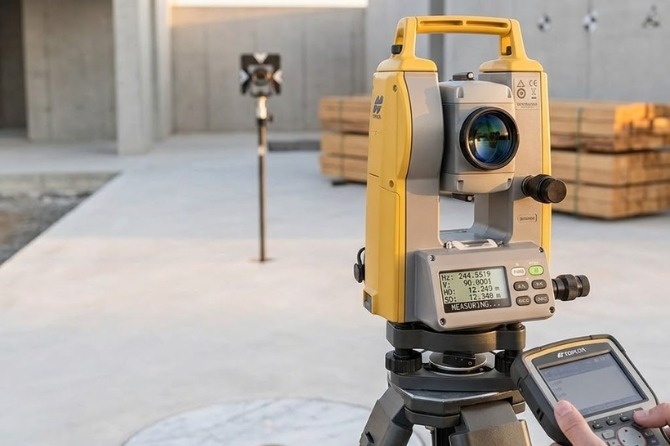
What is Topcon Total Station?
A Topcon Total Station is a tool used by surveyors and construction teams to measure distances, angles, and layout points on a site. It combines a digital theodolite with an electronic distance meter (EDM), making it useful for construction layouts, land mapping, and general surveying work.
Topcon Total Stations are built to be portable and easy to use, letting teams quickly measure points, calculate coordinates, and store data for project planning or 3D modeling. They can measure with prisms or without, which helps reach long distances or difficult-to-access areas, making them versatile for a variety of job sites.
What Are the Features of Topcon Total Station?
Topcon Total Stations are made to help surveyors and construction teams measure distances and angles quickly while capturing layout data on the device. They can measure with or without prisms, save lots of data, and connect easily to software or controllers to keep projects running smoothly.
These instruments are built for tough job sites. Many have water- and dust-resistant housings, touchscreen or easy-to-read displays, and long-lasting power options. Robotic models can automatically follow a prism, letting one person handle tasks that usually need two. Topcon Total Stations are ideal when speed, flexibility, and clear data management are important for the project.
When to Use a Topcon Total Station?
Topcon total stations are best for projects where you need detailed measurements for construction, surveying, or engineering work. They are especially useful when GPS or satellite signals are blocked by buildings, trees, or tunnels.
Typical situations include:
- Construction Layout & Machine Guidance: Setting foundations, walls, or roofs, and helping equipment like graders and dozers follow exact lines.
- Surveying & Mapping: Making 3D maps and calculating earth volumes for site planning.
- Civil Engineering Projects: Measuring and mapping roads, bridges, and railway tracks.
- Challenging GPS Areas: Working in areas with dense trees, tall buildings, or underground where satellite signals are weak or blocked.
- Data Collection & Site Modeling: Capturing measurements and sending them to software or controllers for fast planning and layout.
Pros and Cons of Topcon Total Station
Before choosing a Topcon total station, it’s helpful to know where it shines and where it might have limitations. These instruments are built for projects that benefit from automation and fast data collection, but some features may require learning or extra care.
Pros
- Fast and Automated: Robotic models can track targets quickly, saving time and letting one person handle tasks that usually need a team.
- Single-Operator Friendly: Many models are designed for one-person use, reducing labor needs on the job site.
- Flexible Measurement Options: Hybrid models can switch between GNSS (satellite) and optical measurements, useful when line-of-sight is blocked.
- Easy Software Integration: MAGNET Field software helps move data between field and office smoothly, with map-based tools for planning and layout.
- Built for Tough Sites: Many models resist dust and water (IP65/IP66), making them suitable for harsh job site conditions.
- Good Value: Topcon often offers more affordable options than high-end brands while keeping high performance.
Cons
- Extra Care Needed: Older models may have battery or cable problems, and robotic systems may use more power.
- Software Takes Time: The automation and software features may take time to understand.
- Optics: While good, some users prefer competitors for the clearest view when manually sighting points.
- Regular Maintenance Required: Electronic parts need routine professional calibration to keep the instrument performing well.
Nikon vs Topcon Total Stations: Price Comparison
| Model / Category |
Nikon Total Station Price (USD |
Topcon Total Station Price (USD) |
| Entry / Basic Units |
~ $6,000+ (NPL-322 Series) |
~ $5,500+ (GM-50 Series) |
| Mid-Range Reflectorless |
~ $9,500+ (XS Series) |
~ $7,500+ (GM-100 Series) |
| Advanced Reflectorless |
~ $11,500+ (XF Series) |
~ $9,000+ (GM-101 / GM-105 Models) |
| Robotic / High-End |
(Robotic Nikon models typically quoted by dealers) |
~ $25,000+ (GT Series Robotic Total Stations) |
| Premium Automation |
Custom quote depending on configuration |
~ $30,000+ (Topcon GTL / Advanced Robotic Models) |
Note: Please keep in mind that the nikon total station price and Topcon rates listed here are estimates.
Nikon vs Topcon Total Stations
When comparing Nikon and Topcon total stations, it’s important to look at features, operation, and project requirements. Nikon models are suited for manual and semi-manual surveying with clear optics and simple data handling, while Topcon units, including robotic models, offer automation and advanced tools for faster measurements and single-person operation.
| Feature |
Nikon |
Topcon |
| Operation |
Mostly manual or semi-manual |
Manual and robotic options |
| Optics |
Bright and clear |
Good optics with automation support |
| Distance Measurement |
Up to ~800 m reflectorless |
Up to ~1000 m on some models |
| Data Handling |
Bluetooth and USB transfer |
MAGNET Field software integration |
| Battery |
Hot-swappable batteries |
Long-lasting batteries |
| Portability |
Lightweight |
Robotic models slightly heavier |
| Automation |
Limited |
Advanced robotic tracking |
Best For |
Clear sighting and simple operation |
Automation and large job sites |
Nikon vs Topcon Total Stations: Which Should You Choose?
Choosing the right total station depends on your project needs, site conditions, and workflow:
- Nikon Total Stations: Best for projects that need clear sighting, easy data handling, and portability. They work well on small to mid-sized sites or where hands-on control is preferred.
- Topcon Total Stations: Shine on larger or complex projects where speed, automation, and single-person operation can save time and effort. They are ideal when working in areas with limited GPS signals or for fast, automated measurements.
Ready to Pick the Right Total Station?
At Engineer Supply we help surveyors and construction teams find the total station that fits your project. Whether you want the hands-on control of a Nikon or the automation and speed of a Topcon, our experts can guide you to the right choice.
For a Quote or Personalized Guidance: Contact our sales team
Call or Text: 434-755-7717 | Email: sales@engineersupply.com
Need Help with Your Total Station?
Have questions about setup, operation, or keeping your instrument working smoothly? Our Service repair team can help with orders and general inquiries, while our technicians handle calibration, repair, and maintenance to keep your total station ready for the field.
Customer Service: 800-591-8907
Repairs & Maintenance: Call or Text 434-200-8477
More Articles on Nikon