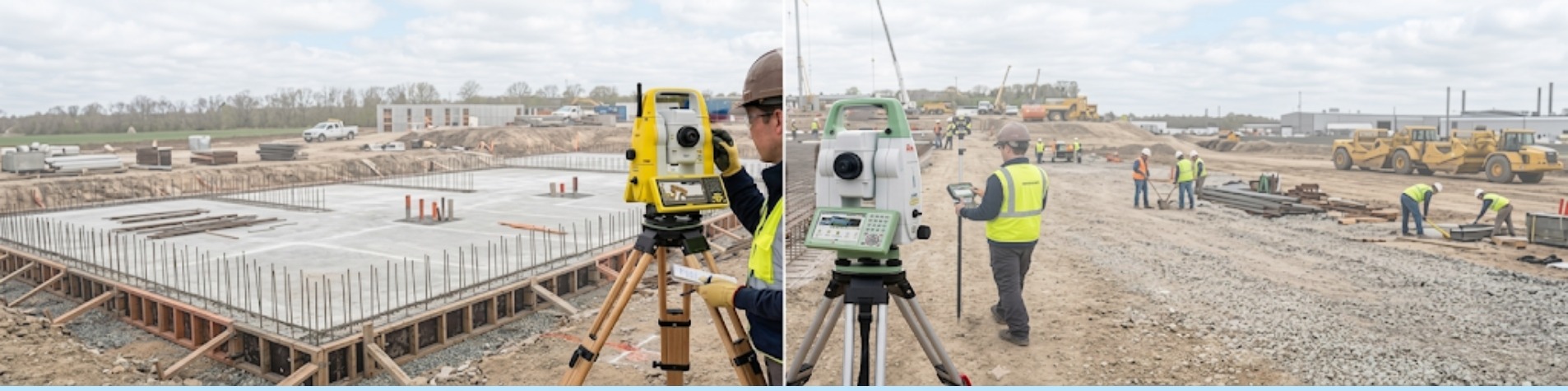
The total station you use can affect how your work goes each day. It can change how fast you finish tasks, how many people you need, and how easy things feel on site.
Right now, many teams are choosing between the Leica TS13 total station and manual total stations. Both can get the job done, but they don’t work the same way.
This guide will help you see the difference. We’ll keep it simple and focus on what really matters, so you can choose what fits your team and your projects.
What is Leica TS13?
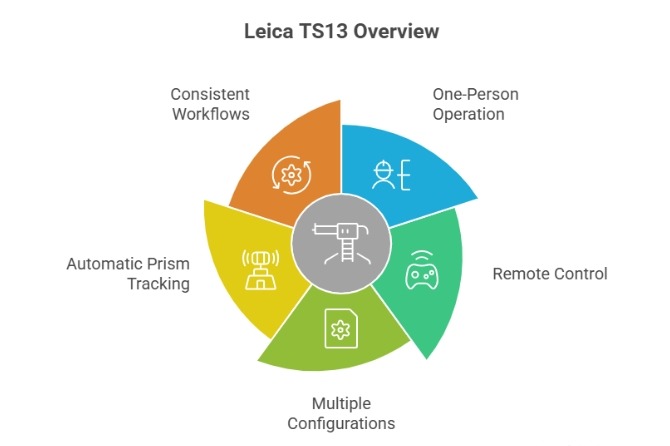
The Leica TS13 is a robotic total station designed for one-person operation in surveying and construction applications. It enables remote control of the instrument using a handheld controller, reducing the need for a second operator at the instrument setup.
It is available in multiple configurations, including 1″, 2″, and 3″ angle options, as well as R500 and R1000 reflectorless measurement ranges. These configurations allow teams to align the instrument with specific requirements for measurement detail and working distance.
The system automatically tracks the prism during operation, allowing continuous measurement without manual realignment. This supports consistent field workflows and reduces interruptions during data collection.
Key Features of Leica TS13
The Leica TS13 robotic total station is made for one-person surveying, letting a single operator control the instrument and finish field tasks without needing help at the setup.
It comes with accuracy options from 1″ to 3″, giving you flexibility based on the level of detail your project needs. It also uses Automatic Target Recognition (ATR) to find and track the prism while you work, helping reduce manual steps.
With reflectorless options like R500 and R1000 you can measure distances even without a prism, which is useful for hard-to-reach areas. Leica Captivate software gives a clear view of your data on site, while AutoHeight helps speed up setup by recording instrument height automatically.
It also supports Bluetooth, Wi-Fi, USB, and SD for easy data transfer, making it simple to move files between devices.
When the Leica TS13 is Used
The Leica TS13 is suited for projects requiring efficient data collection, reduced manpower, and consistent field accuracy.
Common applications include:
- Civil engineering and infrastructure development
- Utility mapping and verification surveys
- Construction sites requiring fast layout execution
- Field environments with limited crew availability
- Locations where direct access is restricted or unsafe
Leica TS13 – Operational Advantages and Considerations
Before choosing the Leica TS13 total station robotic package, it helps to know what it can do well and where it may not be the best fit. It is made for surveying, construction, and engineering work where one person can handle the job on site.
Advantages
- Supports one-person operation and reduced field crew requirements
- Improves workflow efficiency through automated tracking
- Offers flexible configurations for different project requirements
- Reduces manual steps in setup and measurement
- Designed for professional field environments
Considerations
- Performance varies depending on selected configuration
- Advanced functionality may depend on integrated system setup
- Best performance achieved within Leica workflow ecosystem
In short, the Leica total station robotic package is good for one-person work, faster field tasks, and easy setup, but bigger or more complex projects may need more advanced equipment.
What is Manual Total Stations?
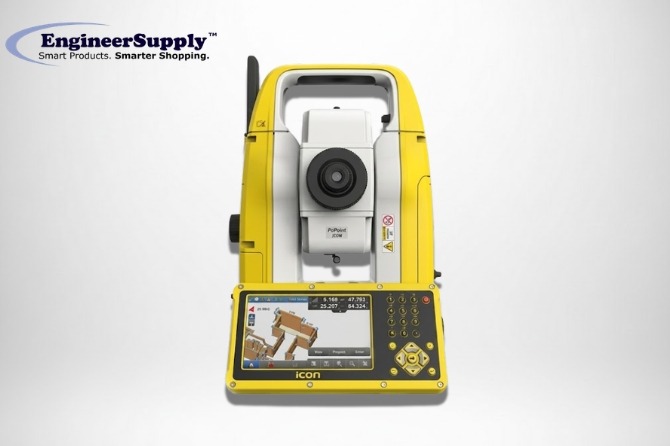
A manual total station is a surveying instrument used to measure horizontal and vertical angles, as well as distances, during field operations.
Unlike robotic systems, it requires direct operator control for aiming, measurement, and recording. In most applications, it operates as a two-person workflow, with one operator at the instrument and another holding the prism.
Manual total stations are widely used for standard surveying tasks due to their simplicity and cost efficiency.
Key Features of Manual Total Stations
A manual total station is used to measure angles, distances, and points on a site, commonly in construction, land surveying, and mapping. It is operated by hand, so the user aims at the target, focuses, and records each measurement. It combines angle and distance measurement in one device, making it useful for many field tasks. It is often used for layout work, boundary marking, and basic surveying, and most models can store data for later use. Some units support reflectorless measurement, allowing distance readings without a prism, which is helpful when targets are hard to reach. It is designed for outdoor use and can handle dust, heat, and light rain, and it is more affordable than robotic total stations, making it a good option for small to medium projects.
When Manual Total Stations Are Used
Manual total stations are suited for projects that require exact measurements without the need for automation.
Common applications include:
- Construction layout and basic site marking
- Boundary and land surveying
- Training and entry-level fieldwork
- Small to medium-scale site measurements
- Projects with limited budgets
- Fieldwork involving two-person crews
Leica TS13 – Operational Advantages and Considerations
Before choosing a manual total station surveying equipment, it helps to understand its strengths and limits. It is mainly used for simple surveying tasks and small to medium projects where manual operation is enough.
Advantages
- More Affordable: Manual total stations cost less to buy and maintain, making them a good option for budget-friendly projects.
- Simple Operation: Easy to use since it has fewer advanced features and a straightforward setup process
- Good for Basic Survey Work: Works well for layout marking, boundary work, and small site measurements.
- Quick Setup: Can be prepared and used quickly for simple field tasks without complex steps.
Consideration
- Needs Two Operators: One person works on the instrument while another holds the prism, so more manpower is needed.
- Slower Work Process: All aiming and readings are done manually, which takes more time to finish tasks
- Depends on User Handling: Results can vary depending on how carefully the user aims and records measurements.
- No Automation Features: Lacks automatic tracking and advanced functions, making large projects more time-consuming.
Leica TS13 vs Manual Total Station
Both systems support surveying and construction workflows, but differ significantly in operational structure and efficiency.
| Feature |
Leica TS13 Robotic Total Station |
Manual Total Station |
| Operation |
One-person robotic control |
Manual operator control |
| Crew Requirement |
Single operator |
Typically two operators |
| Measurement Process |
Automated prism tracking |
Manual aiming and reading |
| Workflow Speed |
Higher efficiency |
Slower due to manual steps |
| Setup |
Assisted digital setup tools |
Manual configuration |
| Data Handling |
Multiple digital transfer options |
Basic onboard storage |
| Best Application |
Complex, high-efficiency projects |
Simple, smaller-scale work |
| System Cost |
Higher investment |
Lower entry cost |
Selection Guidance
The right total station depends on project scale, workflow requirements, and operational needs.
- The Leica TS13 robotic total station supports workflows requiring higher efficiency, reduced manpower, and automated field processes
- The manual total station remains suitable for basic surveying tasks where simplicity and cost control are priorities.
Engineer Supply Equipment and Lifecycle Support
Engineer Supply is a professional solutions company serving surveying, construction, and geospatial professionals.
We provide professional-grade instruments along with technical support and lifecycle services such as calibration, repair, diagnostics, and maintenance. Our support goes beyond supplying equipment. We help customers throughout the full equipment lifecycle, from setup to long-term use.
For a Quote or Personalized Guidance:
Call or Text: 434-755-7717
Email: sales@engineersupply.com
Need Assistance with Your Equipment?
Our service and repair team are here to help with calibration, repairs, and general maintenance services you might need.
Customer Support: 800-591-8907
Repairs & Maintenance: Call or Text 434-200-8477
More Articles on Nikon